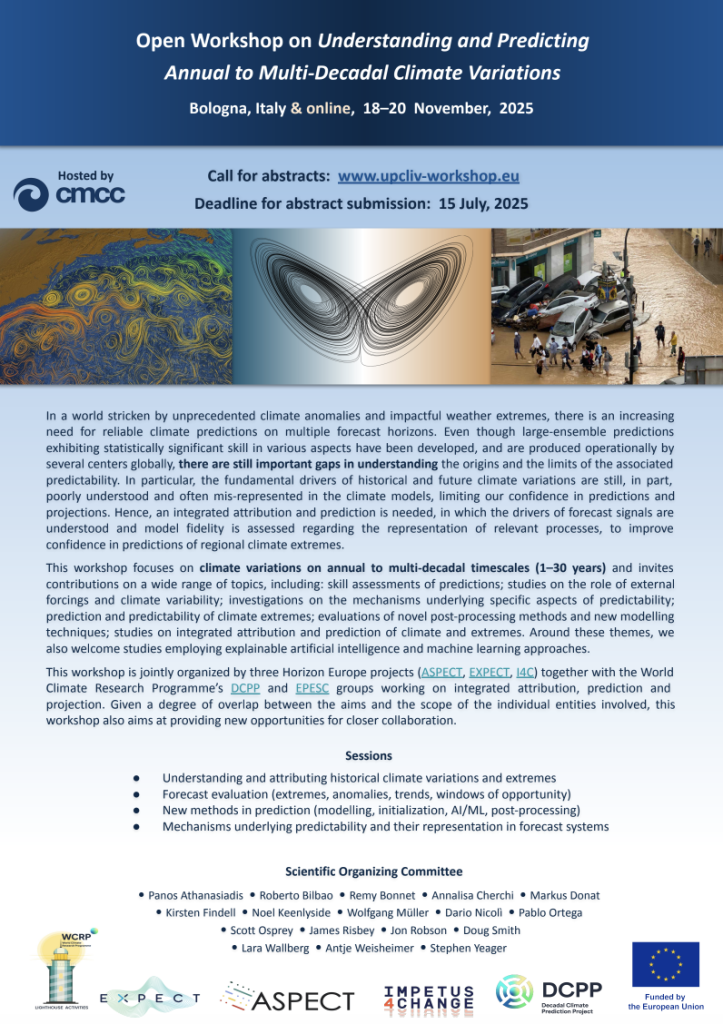
Bologna, Italy & online, 18–20 November, 2025
In a world stricken by unprecedented climate anomalies and impactful weather extremes, there is an increasing need for reliable climate predictions on multiple forecast horizons. Even though large-ensemble predictions exhibiting statistically significant skill in various aspects have been developed, and are produced operationally by several centers globally, there are still important gaps in understanding the origins and the limits of the associated predictability. In particular, the fundamental drivers of historical and future climate variations are still, in part, poorly understood and often mis-represented in the climate models, limiting our confidence in predictions and projections. Hence, an integrated attribution and prediction is needed, in which the drivers of forecast signals are understood and model fidelity is assessed regarding the representation of relevant processes, to improve confidence in predictions of regional climate extremes.
This workshop focuses on climate variations on annual to multi-decadal timescales (1–30 years) and invites contributions on a wide range of topics, including: skill assessments of predictions; studies on the role of external forcings and climate variability; investigations on the mechanisms underlying specific aspects of predictability; prediction and predictability of climate extremes; evaluations of novel post-processing methods and new modelling techniques; studies on integrated attribution and prediction of climate and extremes. Around these themes, we also welcome studies employing explainable artificial intelligence and machine learning approaches.
This workshop is jointly organised by three Horizon Europe projects (ASPECT, EXPECT, I4C) together with the WCRP’s DCPP and EPESC groups working on integrated attribution, prediction and projection. Given a degree of overlap between the aims and the scope of the individual entities involved, this workshop also aims at providing new opportunities for closer collaboration.
Oral sessions:
| Participant | Participation | Date | Time | Abstract title |
| Gerard Marcet-Carbonell | In person | Nov./18 | 09:50–10:10 | Driver attribution of changes in Northern Hemisphere Summer Atmospheric Circulation using LESFMIP simulations. |
| Melissa Seabrook | In person | Nov./18 | 10:10–10:30 | External Forcing of Historical Multidecadal Variability in the Pacific in Large Ensembles |
| Julia Mindlin | In person | Nov./18 | 11:50–12:10 | Explaining and predicting the Southern Hemisphere Eddy Driven Jet |
| Antje Weisheimer | In person | Nov./18 | 12:30–12:50 | CO2-induced Climate Change Assessment for the extreme 2022 Pakistan Rainfall using Seasonal Forecasts. |
| Christopher Kadow | In person | Nov./19 | 11:20–11:40 | Bridging Sparse Observations: Transfer‑Learning Neural Networks Enhance North Atlantic and Europe Seasonal2Annual Climate Predictions. |
| Markus Donat | In person | Nov./20 | 09:40–10:00 | Towards understanding the sources of forecast signals and skill in interannual to decadal climate predictions. |
Poster sessions:
| Participant | Participation | Date | Time | Abstract title |
| Daniel J. Befort | In person | Nov./18 | 14:10–18:30 | Seasonal to decadal prediction of extremes. |
| Jacob W Maddison | In person | Nov./18 | 14:10–18:30 | Seasonal predictions of summertime temperature extremes and their links to trends in the large-scale atmospheric circulation. |
| Stefano Materia | In person | Nov./18 | 14:10–18:30 | Growing importance of soil moisture precondition for summer heatwaves in the Western Mediterranean. |
| Michael Mayer | In person | Nov./18 | 14:10–18:30 | Representation of tropical Pacific trends in counterfactual seasonal hindcast experiments. |
| Ned Williams | In person | Nov./18 | 14:10–18:30 | Understanding Predictability of the North Atlantic Oscillation. |
| Arnau Garcia Mesa | In person | Nov./19 | 14:00–18:30 | Quantifying drivers of temperature extremes through explainable machine learning models. |
| Doug Smith | In person | Nov./19 | 14:00–18:30 | The need to account for model error in prediction, projection and attribution. |
| Fiona R. Spuler | In person | Nov./19 | 14:00–18:30 | Identifying predictable dynamical drivers of extreme precipitation using causal representation learning. |
| Rikke Stoffels | In person | Nov./19 | 14:00–18:30 | Using an explainable neural network to identify tropical drivers of the Northern Hemisphere wave-5 trend pattern. |
| Vincent Verjans | In person | Nov./19 | 14:00–18:30 | Evaluating causality to filter large ensembles for decadal climate predictions. |
| Étienne Plésiat | In person | Nov./19 | 14:00–18:30 | Deep Learning for Historical Climate Data Reconstruction. |
Scientific Organising Committee:
• Panos Athanasiadis, Roberto Bilbao • Remy Bonnet • Annalisa Cherchi • Markus Donat • Kirsten Findell • Noel Keenlyside • Wolfgang Müller • Dario Nicolì • Pablo Ortega • Scott Osprey • James Risbey • Jon Robson • Doug Smith • Lara Wallberg • Antje Weisheimer • Stephen Yeager
Speakers affiliated with EXPECT:
Gerard Marcet-Carbonell • Melissa Seabrook • Julia Mindlin • Antje Weisheimer • Christopher Kadow • Markus Donat
Poster presenters affiliated with EXPECT:
Daniel J. Befort • Michael Mayer • Ned Williams • Stefano Materia • Jacob W Maddison • Rikke Stoffels • Arnau Garcia Mesa • Doug Smith • Étienne Plésiat • Fiona R. Spuler • Vincent Verjans • Julianna Carvalho Oliveira
Any questions?
Contact upcliv-workshop@cmcc.it to get more information about the workshop.
Download Workshop Flyer