Europe has just experienced another summer that shows how rapidly the continent’s climate is changing. June and July 2026 brought exceptionally high temperatures across the continent, with Western Europe recording its warmest June–July period on record. July was also the joint-second warmest July globally, tied with July 2024, according to the Copernicus Climate Change Service.
The heat came with a cascade of impacts. Much of Western, Central and Eastern Europe experienced drier-than-average conditions, with both a lack of rainfall high temperatures driven by persistent high-pressure systems contributing to drought alongside the extreme heat. The hot and dry conditions drove exceptional wildfire activity, while river flows fell to very low levels in many affected regions. The extremes extended beyond land: July saw the highest global extra-polar ocean surface temperatures on record, with exceptionally warm waters along Europe’s coastline and across the Mediterranean. The World Weather Attribution initiative found that the exceptionally high sea surface temperatures recorded around Europe in 2026 were made substantially more likely and intense by human-induced climate change. In the Western Mediterranean, sea surface temperatures were around 3.1°C higher than they would have been in a cooler climate, while an event of this magnitude would have been virtually impossible in a pre-industrial climate.
Together, these extremes across Europe’s land, atmosphere and oceans raise a broader question: what is driving this increasingly extreme summer weather, and what can it tell us about the summers Europe may face in the future?
What is driving europe’s rapid summer warming?
While global warming, driven primarily by increasing greenhouse gas concentrations from burning fossil fuels, causes higher temperatures across the globe, some regions are warming faster than others. Europe in particular is the fastest warming continent, and the EU-funded EXPECT project investigates what drives these rapid increases in summer temperatures and heat extremes in Europe. One piece of this puzzle is explored in a recent study by EXPECT researchers, Accelerated European Summer Warming Driven by Atmospheric Circulation Changes in Response to Aerosol Forcing.
The study finds that climate models have underestimated the recent rise in European summer temperatures compared with observations. The researchers identify changes in large-scale atmospheric circulation as one important reason for this gap, particularly trends in quasi-stationary Rossby waves – persistent atmospheric patterns that can influence the distribution and accumulation of heat across Europe.
These circulation changes are linked to external climate forcings, with the study pointing in particular to the role of declining sulphate aerosol emissions in Europe since around 1980. As aerosol emissions have decreased, they have contributed to changes in atmospheric circulation that affect the distribution of summer temperatures across the continent. Climate models reproduce these processes and their overall influence on European summer temperatures, but underestimate their magnitude compared with observations.
The findings highlight the importance of accounting for model biases and uncertainties when assessing both past and future changes in Europe’s climate. Climate models remain essential tools for understanding and projecting climate change, but correcting for these limitations can provide a more accurate picture of how rapidly European summers are warming.
The study does not explain any single summer in isolation. Instead, it sheds light on the longer-term processes contributing to Europe’s increasingly warm summers, providing important context for the exceptional heat observed in 2026. As Europe experiences increasingly frequent and intense heat extremes, understanding these underlying processes is becoming ever more important for anticipating what future summers may look like.
When climate research reaches wider audiences
The EXPECT study has also attracted significant attention beyond the scientific community, with findings featured by both national and international media outlets, including, among others, the Spanish newspaper El Periódico, and The Guardian.
Coverage of the study by major national and international outlets shows how questions once discussed primarily within the scientific community are increasingly becoming part of the wider conversation about Europe’s changing climate. While the news itself is, of course, concerning for the planet, the attention given to the research demonstrates the value of bringing robust scientific evidence into public conversations about climate change.
“The EXPECT project works to understand the reasons behind the rapid increase in European summer temperatures and extremes, and uses the understanding to develop more accurate estimates of future changes. This information is crucial for Europe to adapt to the climate conditions it will be exposed to in the coming years and decades”. – Markus Donat, Scientific Project Coordinator
Unpacking the summer of 2026: hear directly from climate scientists
The exceptional summer of 2026 demonstrates why this research matters. Record-breaking temperatures, extreme dryness, wildfires and unusually warm European seas are not isolated phenomena: they are part of a broader picture of a rapidly changing climate.
Understanding why these events are happening, how different parts of the climate system interact, and what they may mean for the future is essential for scientists, policymakers, cities and communities preparing to adapt.
And there is still much to unpack.
If you are a journalist looking to understand what made summer 2026 so extraordinary – and what it could tell us about the summers ahead – EXPECT and the EU-funded Impetus4Change (I4C) project are bringing researchers together for an online press conference on 21 September, from 11:30 to 12:30 CEST.
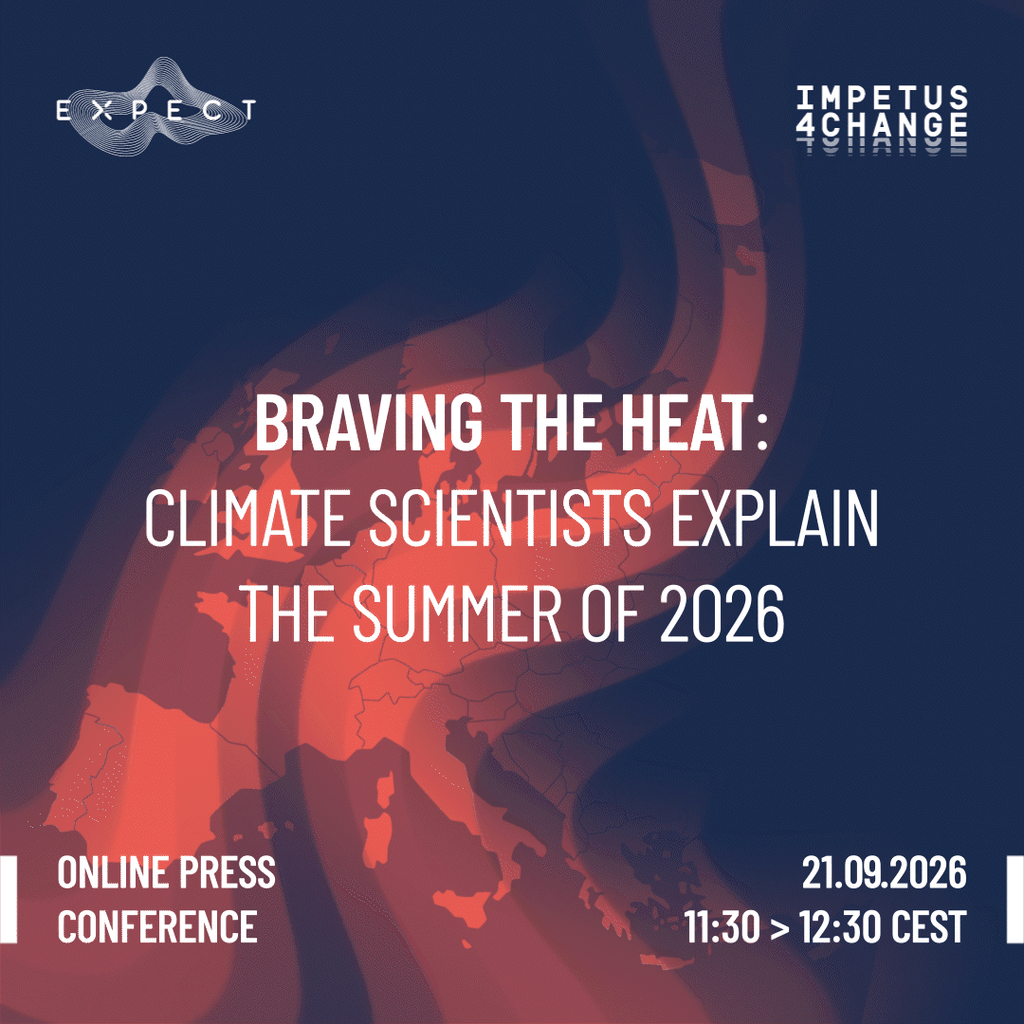
“Facing the Heat: Climate Scientists Explain the Summer of 2026” will bring together scientists from both projects to explain what happened this summer, why it happened, and what the latest climate evidence tells us about what comes next.
Journalists will also have the opportunity to ask questions directly to researchers about topics including:
- Why Europe is the fastest-warming continent and what is driving the acceleration, from atmospheric circulation to land–atmosphere feedbacks and human activity;
- What climate models can – and cannot – tell us about the future, including advances in high-resolution modelling and machine learning;
- What extreme heat could look like in European cities in the years and decades ahead.
Interested in joining?
Register your interest and submit your questions in advance. Click here.