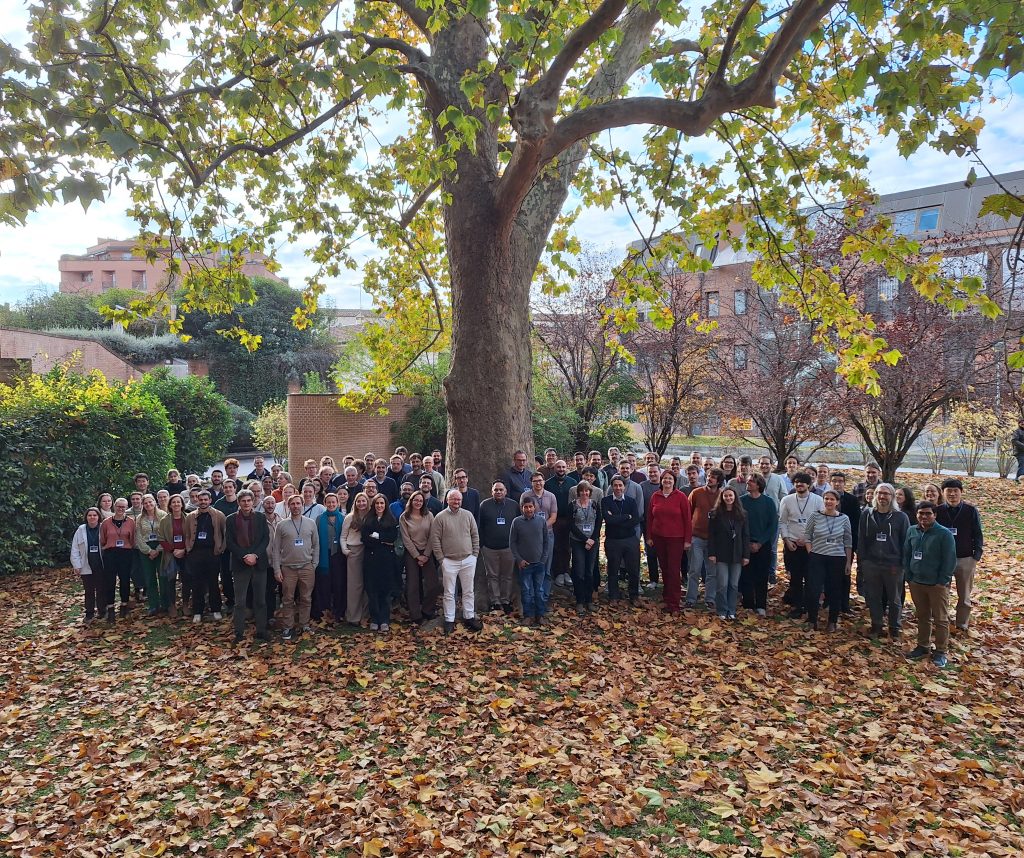
From 18 to 20 November 2025, the Open Workshop on Understanding and Predicting Annual to Multi-Decadal Climate Variations (UPCLIV Workshop) brought together researchers from the EXPECT, ASPECT and Impetus 4 Change Horizon Europe projects, along with the WCRP’s DCPP and EPESC groups. Across three days of scientific exchange, 17 contributions from the EXPECT project highlighted advances in understanding climate variability, extremes, and predictability, as well as new methodological developments in machine learning and model evaluation.
Day 1
The opening day featured a rich collection of talks and posters exploring the drivers of circulation changes and climate extremes. Gerard Marcet Carbonell began the day with his oral presentation “Driver attribution of changes in Northern Hemisphere Summer Atmospheric Circulation using LESFMIP simulations”. Reflecting on his findings, the PhD researcher at Barcelona Supercomputing Center (BSC-CNS) noted:
“Regional accelerated warming in different regions of the world, including Western Europe, has been associated with changes in the circulation of the atmosphere. In the work I presented in Bologna we studied what could have caused the changes in atmospheric circulation and found evidence for changes in aerosol emissions being a key driver.”
Gerard Marcet Carbonell, PhD researcher at BSC-CNS.
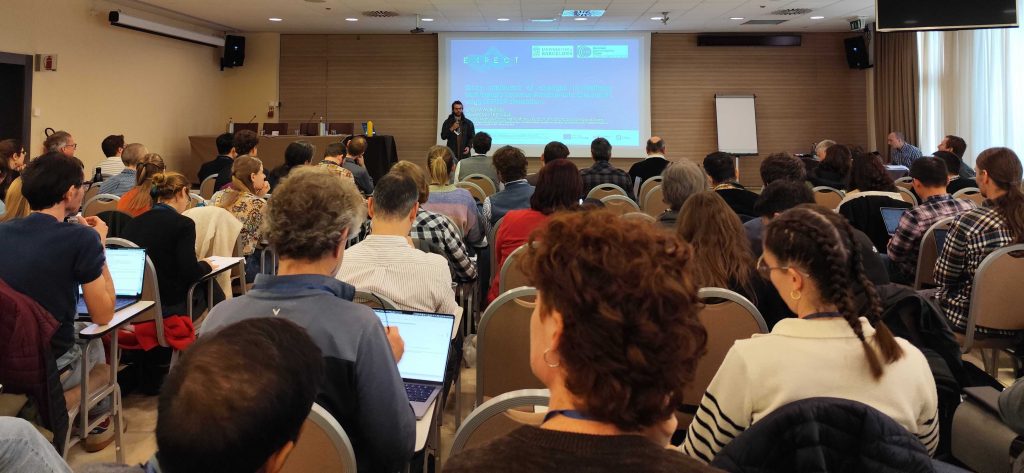
Melissa Seabrook, Climate Scientist at Met Office, followed with her presentation “External Forcing of Historical Multidecadal Variability in the Pacific in Large Ensembles”, exploring the external forcing of multidecadal Pacific variability and highlighting why models fail to reproduce observed circulation trends and often underestimate the forced signal.
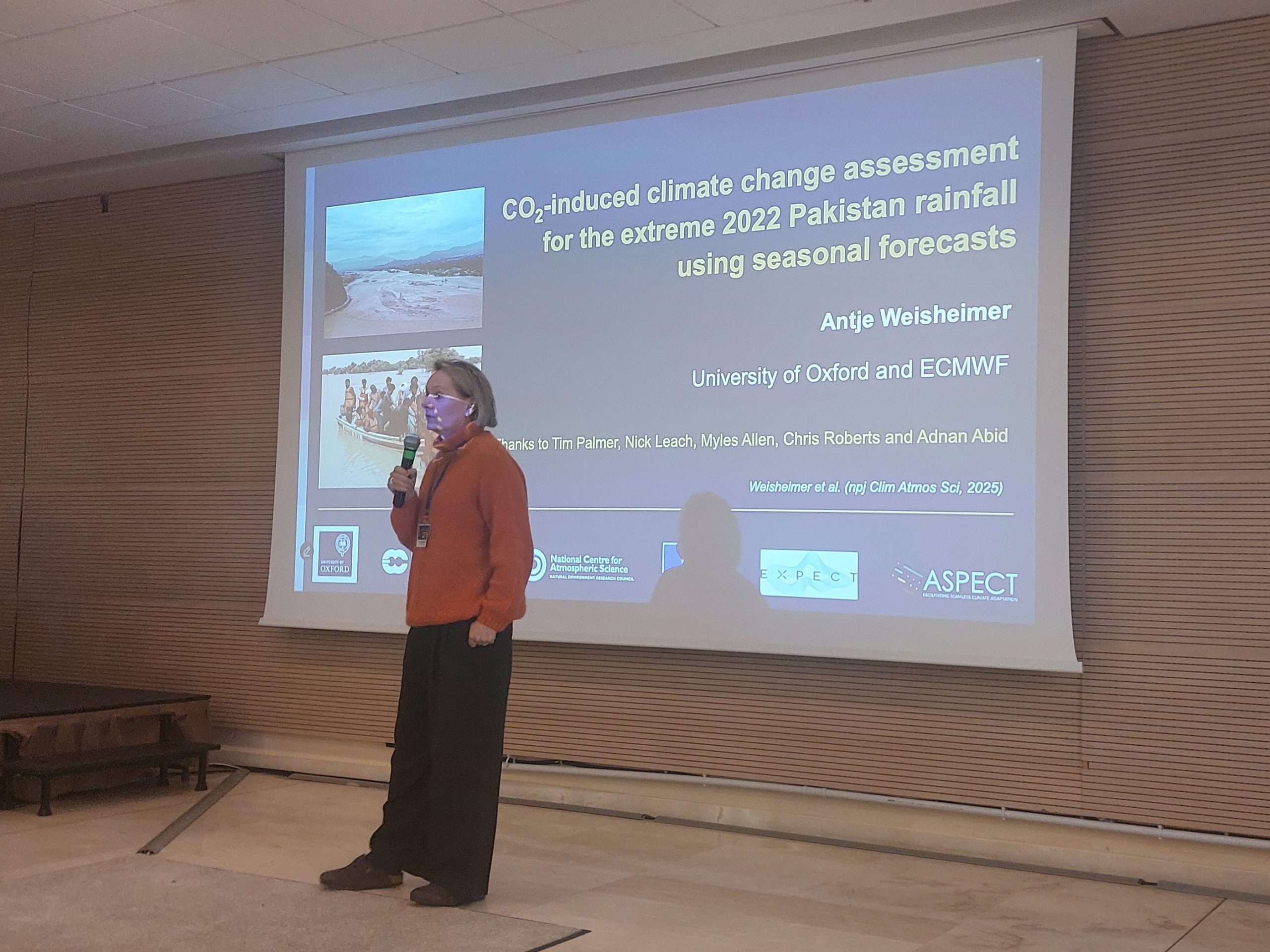
Julia Mindlin, Postdoctoral Researcher at the University of Leipzig, then shifted focus to the Southern Hemisphere in her presentation “Explaining and predicting the Southern Hemisphere Eddy Driven Jet”, while Dr Antje Weisheimer, Senior Researcher at the European Centre for Medium-Range Weather Forecasts (ECMWF), hosted the last EXPECT oral presentation of the day with “CO₂-induced Climate Change Assessment for the Extreme 2022 Pakistan Rainfall using Seasonal Forecasts”, an analysis of anthropogenic influences on the devastating 2022 flooding event.
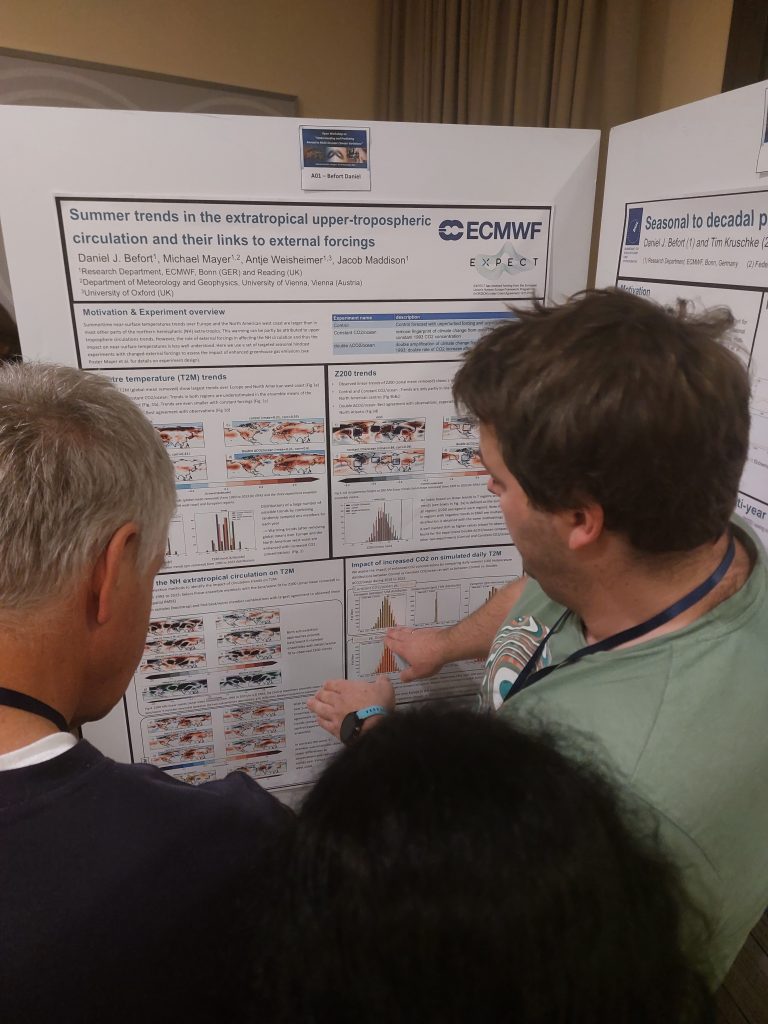
The poster session broadened the discussions introduced earlier in the day, and started with the contribution of two ECMWF researchers. Dr Daniel J. Befort, presented his work on “Seasonal to decadal prediction of extremes”, and Jacob W. Maddison contributed with the poster “Seasonal predictions of summertime temperature extremes and their links to trends in the large-scale atmospheric circulation”. Reflecting on his research, Jacob W. Maddison explained:
“Hindcasts from seasonal prediction systems offer an alternative to free-running simulations for studying trends in the climate system. I showed that a pronounced trend towards a more wavy upper-level flow in reanalysis is not accurately reproduced in the hindcasts, likely due to missing Rossby-wave forcing from the subtropics. Work is ongoing to understand the cause of this model error.”
Jacob W. Maddison, ECMWF researcher.
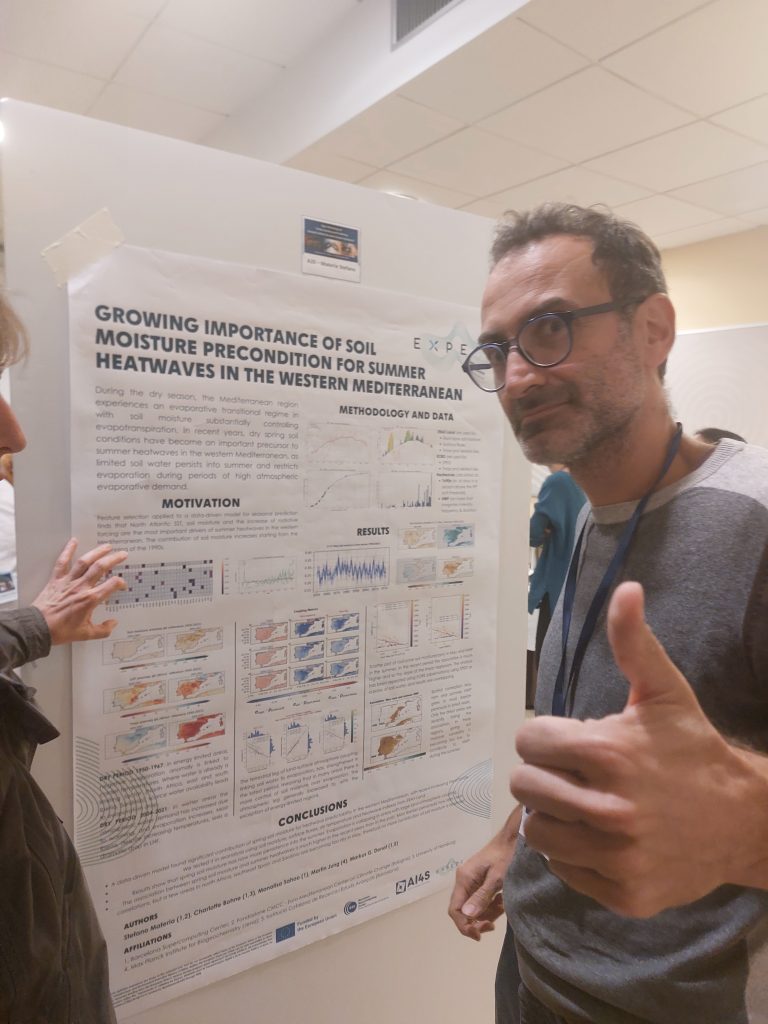
Wrapping up the first day, the closing poster presentation of the EXPECT team was delivered by Stefano Materia, from BSC-CNS, examining the “Growing importance of soil moisture precondition for Western Mediterranean heatwaves”, and with a “Representation of tropical Pacific trends in counterfactual seasonal hindcast experiments” by Michael Mayer.
Day 2
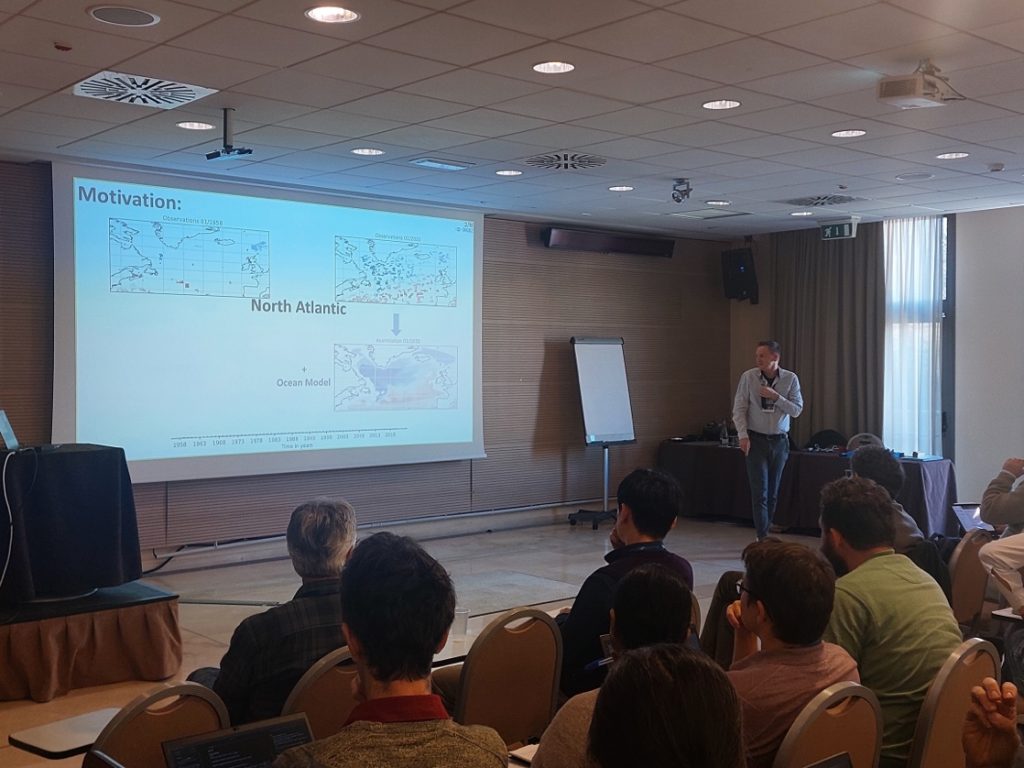
The second day emphasised the rapid emergence of machine learning and causal methods in climate science. Dr Christopher Kadow, Data Analyst at the German Climate Computing Centre (DKRZ), opened the EXPECT contributions with the oral presentation“Bridging Sparse Observations: Transfer Learning Neural Networks Enhance North Atlantic and Europe Seasonal-to-Annual Climate Predictions”.
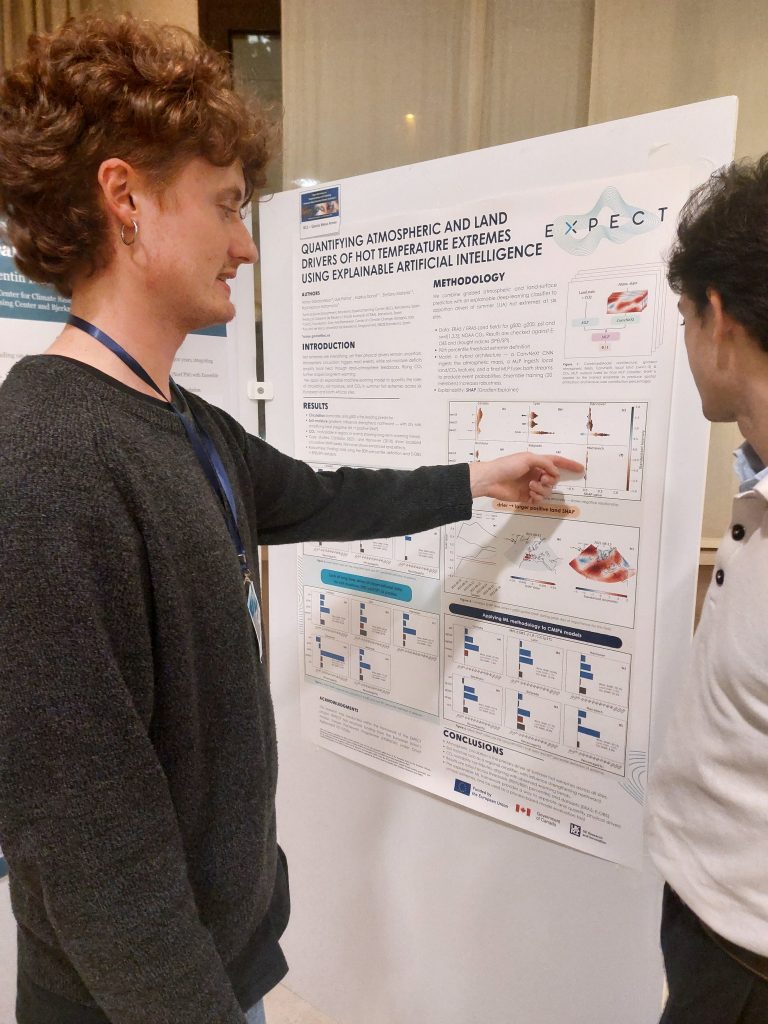
Among the poster contributions, Arnau García Mesa, Junior Researcher Engineer at BSC-CNS, summarised the work he has been doing on quantifying the drivers of hot temperature extremes under the title “Quantifying drivers of temperature extremes through explainable machine learning models”. He explained his work in Bologna as follows:
“We developed a machine-learning methodology to disentangle the roles of atmospheric circulation, soil moisture, and anthropogenic climate change, with the broader goal of assessing the physical consistency of CMIP6 and next-generation models. The work is now submitted to Weather and Climate Dynamics and available as a preprint. Before the poster session, I also introduced the study during the flash talks, and Markus Donat later highlighted its key points in the session on mechanisms underlying predictability.”
Arnau García Mesa, Junior Researcher Engineer at BSC-CNS.
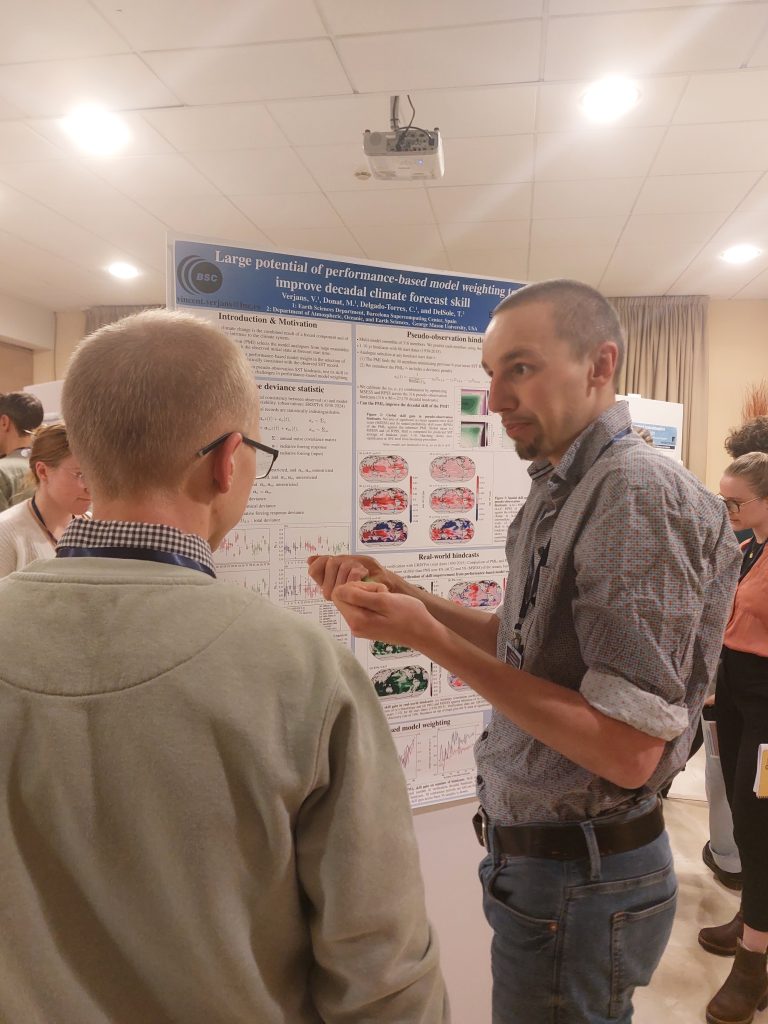
Vincent Verjans, researcher at BSC-CNS, also presented a poster of his latest EXPECT research, under the title “Evaluating causality to filter large ensembles for decadal climate predictions”:
“I introduced a new performance metric—the deviance—used to weight models within large ensembles, demonstrated how to calibrate this approach using pseudo-observational skill assessments, identified sources of improvement in both pseudo-observational and real-world hindcasts, and examined uncertainties between unweighted and weighted ensembles.”
Vincent Verjans, researcher at BSC-CNS.
Other posters broadened the methodological spectrum. Dr Doug Smith, Met Office researcher, discussed “The need to account for model error in prediction, projection and attribution”; Fiona R. Spuler, PhD researcher in climate science at the University of Reading, examined dynamical drivers of extreme precipitation using causal representation learning, “Identifying predictable dynamical drivers of extreme precipitation using causal representation learning.”
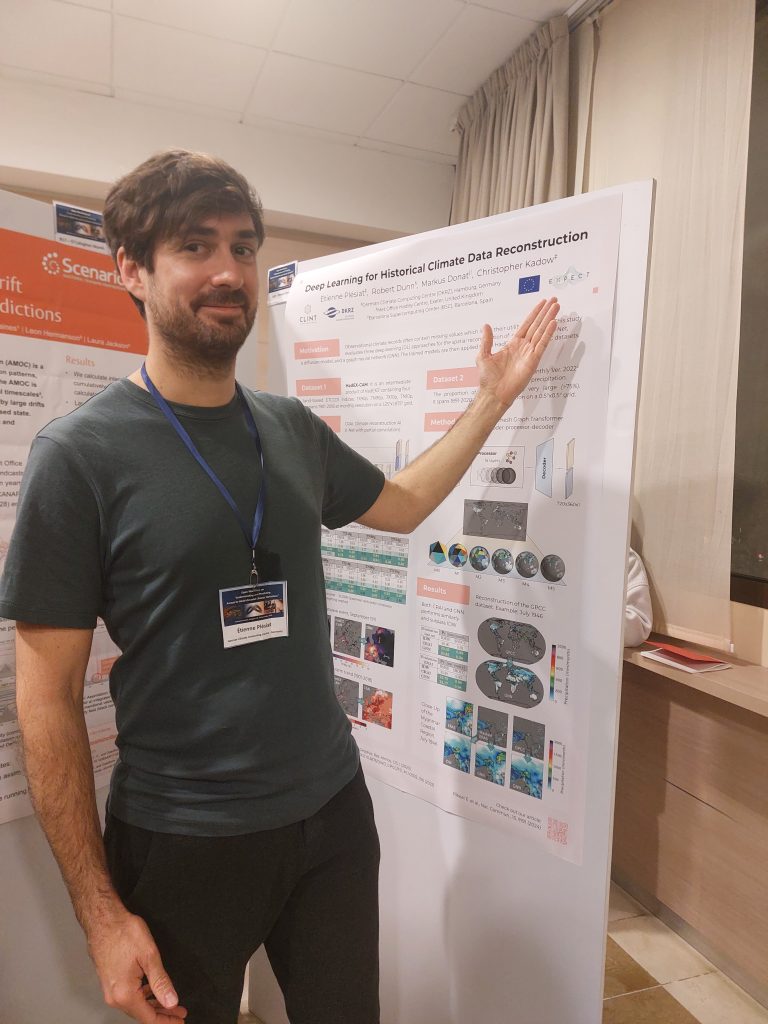
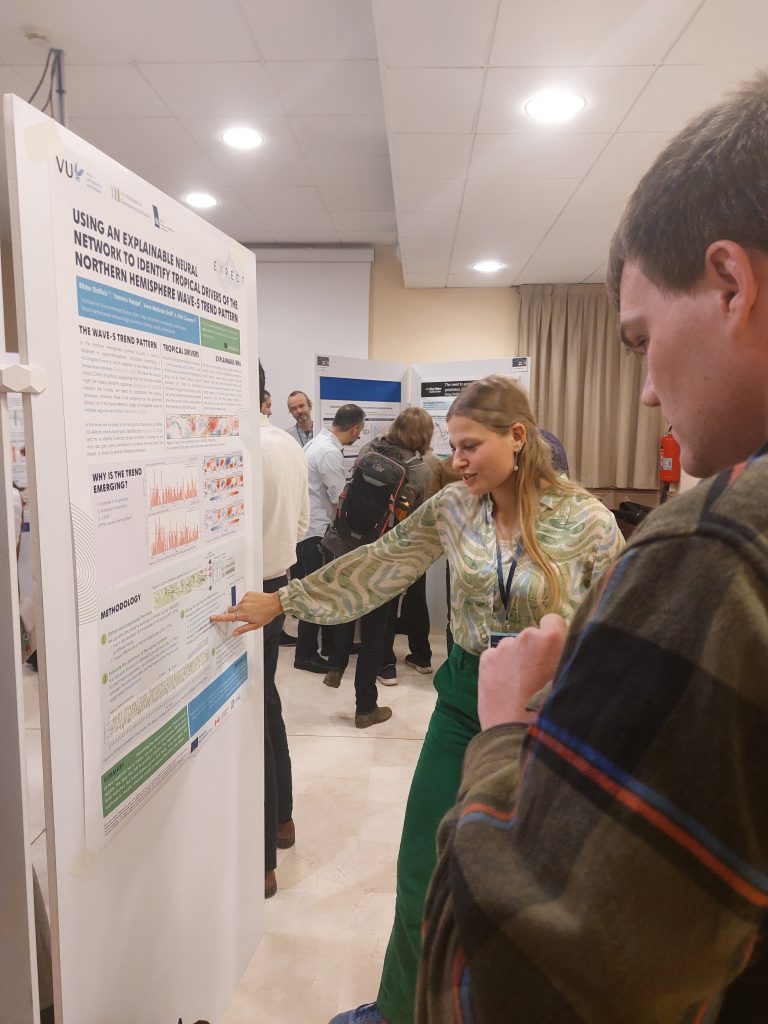
Rikke Stoffels, PhD researcher at Vrije Universiteit Amsterdam (VU Amsterdam), facilitated the poster presentation “Using an explainable neural network to identify tropical drivers of the Northern Hemisphere wave-5 trend pattern”; and Étienne Plésiat, Computational Research Scientist at DKRZ, presented the poster “Deep Learning for Historical Climate Data Reconstruction.” Looking back on her poster presentation, Rikke Stoffels explained:
“I presented a poster outlining the proposed methodology for using an explainable neural network to identify the drivers of the observed trend in upper-atmospheric circulation. This trend resembles a Rossby wave with wavenumber 5, also known as the wave5-pattern. We currently hypothesize that tropical convection has either intensified over time or shifted in space, leading to altered teleconnection patterns. It was beneficial to discuss the range of available explainable AI techniques, and to discuss our working hypothesis with others in Bologna working on similar topics to hear their thoughts on the processes involved.”
PhD researcher at VU Amsterdam.
Day 3
The final EXPECT contribution turned to the origins of forecast skill across timescales. Markus G. Donat, Climate Scientist at BSC-CNS and EXPECT’s project leader, presented “Towards understanding the sources of forecast signals and skill in interannual to decadal climate predictions”, In his presentation, Markus highlighted the importance of scrutinising the predictions in order to understand the mechanisms that provide predictability and contribute to specific forecast signals, and he provided some specific examples using different methods to gain such understanding of predictions.
Reflecting on the event, our project leader noted that it was a great opportunity to bring the community working on physical aspects related to inter-annual to decadal climate predictions together. Bringing more than 100 researchers working on very similar topics into one room, to exchange about their latest progress and discuss fundamental problems, it has been a very worthwhile event.