How do climate scientists see the future they are modelling? At the intersection of narrative psychology and climate science, Junior Research Engineer Gerrit Versteeg explores how scientists craft storylines of future change. The idea is that by making those stories visible, the gap between complex models and real-world decisions might shrink. From coding interviews to visualising narratives, his work aims to humanise research, tackle bias, and make climate science more relatable, and ultimately more actionable.
What is your background and what brought you to study climate narratives?
Gerrit started out in environmental sciences and later specialised in adaptive water management and climate systems. His master’s thesis focused on modelling how climate change could affect water availability in a Spanish river basin by essentially asking, “What would happen 50 years from now? What would happen to the water supply of one of the main rivers and how would that impact society?”
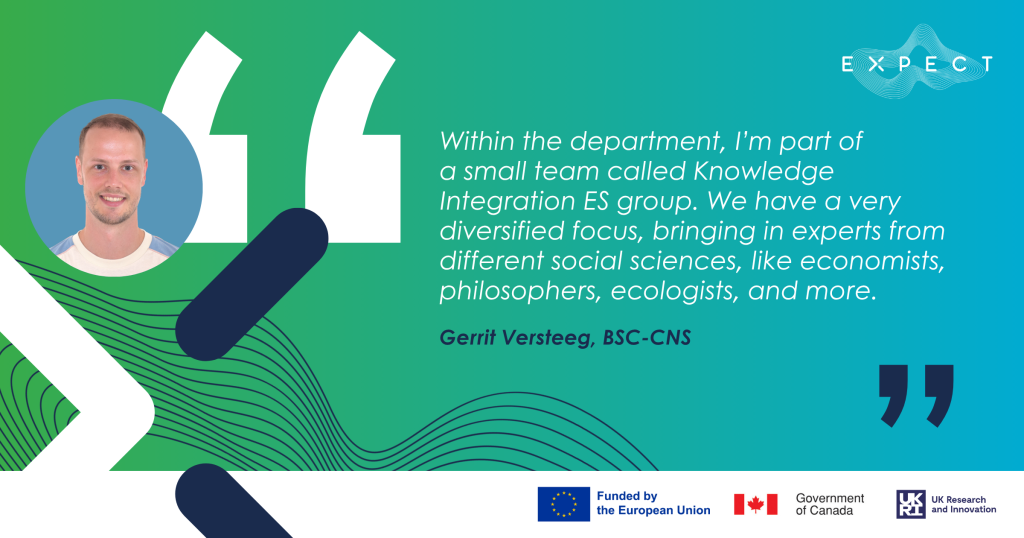
But it was his multidisciplinary interests that led him to join the department of Earth System Services, at the Barcelona Supercomputing Center. “Within the department, I’m part of a small team called Knowledge Integration ES group. We have a very diversified focus, bringing in experts from different social sciences, like economists, philosophers, ecologists, and more,” he explains. That’s where he became more interested in storylines: imagining plausible future climate events, like floods, and exploring how they could impact stakeholders.
What are “storylines,” and how do they differ from traditional approaches?
The conventional way to represent uncertainty in climate science is probabilistic, which means it is based on running large ensembles of model simulations to get probability ranges. But in the face of deep uncertainties, this approach has limits.
Instead, storylines offer “a logically consistent senquence of past developments or possible future scenarios,” Gerrit says. They’re especially useful because:
- they explore the boundaries of plausibility, guarding against false precision and surprise.
- they improve risk awareness by framing risk in an event-oriented way;
- they strengthen decision-making by letting one work backward from specific vulnerabilities or decision points;
- they help partition uncertainty in a physical sense;
We’re on LinkedIn, X, and Bluesky. Follow us there if you haven’t already!