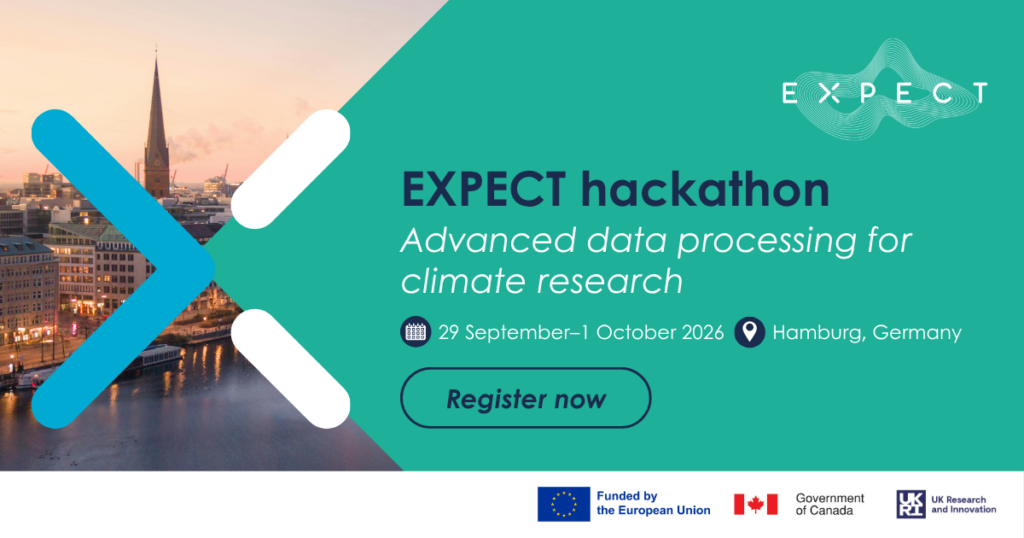
The EXPECT Hackathon on Advanced data processing for climate research will be held in Hamburg, Germany, from 29 September to 1 October 2026. It will bring together PhD students, postdoctoral researchers and professionals to work on climate science challenges applying new data infrastructure developments that enable the efficient analysis of large and distributed data.
The growing data available for climate research, with enhanced resolution and ensemble sizes, presents challenges to efficient and effective analysis. The EXPECT project is developing solutions to this technical challenge, distributed data analysis, to underpin and enable cutting-edge climate research.
The EXPECT hackathon will apply this new data analysis infrastructure to specific scientific challenges. These are:
- understanding changes in atmospheric circulation patterns associated with heat extremes in Europe, in particular double-jet regimes
- building, training and testing Deep Learning models for climate
- downscaling climate data using the ECMWF Weather Generator
- using explainable AI methods to understand the drivers of changes in climate
The Hackathon will provide an introduction to the new distributed climate data processing infrastructure, and then perform hands-on work in small group projects.
Who is it for?
The Hackathon targets PhD students, post-doctoral researchers and professionals eager to exploit the latest advances in climate data infrastructures for process-based and data-driven climate research.
Attendance of the Hackathon will be free of charge. In addition, we have limited funding available to support travel expenses for a limited number of participants, aiming to enhance diversity, equity, and inclusion, by enabling participation of applicants based in low-income or widening countries.
Registration
To register your interest in attending the EXPECT Hackathon, please fill in this Registration Form by May 18th.
Please be aware that you will be asked for the following:
- CV (PDF format, maximum 2 pages)
- a motivation statement (max. 1200 characters)
- Optional: justification in case you apply for travel support (max. 1000 characters)