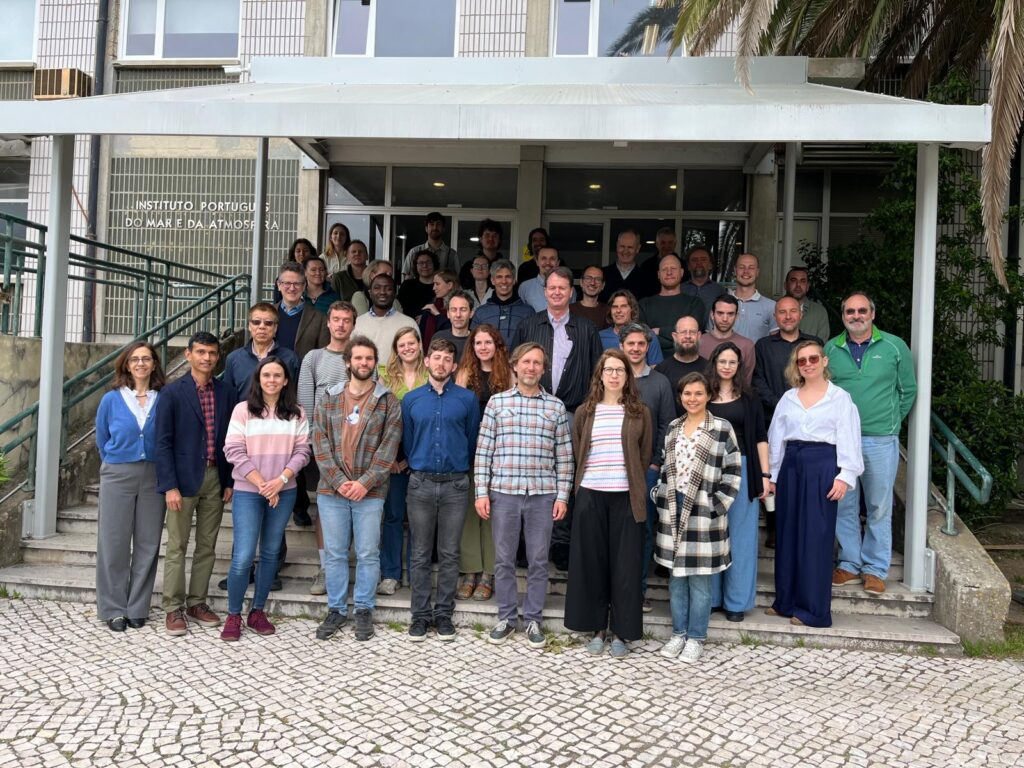
From 14 to 16 April 2026, partners of the Horizon Europe project EXPECT gathered in Lisbon for their second General Assembly, hosted by the Instituto Português do Mar e da Atmosfera (IPMA). Bringing together leading scientists and researchers from across Europe and beyond, the meeting marked a checkpoint for progress, as well as a crucial moment of reconnection.
With contributors from institutions including the Barcelona Supercomputing Center, the University of Oxford, the UK Met Office, CINECA, the Instituto de Astrofísica de Andalucía, the European Centre for Medium-range Weather Forecasts, Universität Hamburg, Universität Leipzig, Universität Heidelberg, Vrije Universiteit Amsterdam, the University of Reading and University of Toronto, EXPECT is a highly distributed effort. While collaboration typically unfolds across time zones and digital platforms, the Lisbon Assembly offered the valuable opportunity for face-to-face discussions, fostering deeper dialogue, spontaneous exchanges, and stronger personal connections across the consortium.
Over three days, participants engaged in a rich and interdisciplinary programme centred on the project’s four scientific themes. Each theme was explored through dedicated sessions combining concise progress updates with open discussions on challenges and next steps. These conversations benefitted greatly from the in-person setting, enabling more nuanced debate and immediate feedback on complex topics such as the integration of AI and machine learning with climate prediction systems.
The gathering also featured a lively poster session, creating space for informal interaction among early career researchers who were able to share their work, receive feedback, and explore potential collaborations in a more immediate way than virtual formats typically allow.
The Assembly also highlighted another essential dimension of EXPECT’s work: how to communicate complex climate research beyond the ivory tower of academia. Building on the momentum of in-person discussions, participants shifted focus from analysing data to shaping narratives, exploring how their findings can inform, engage, and resonate with wider audiences. Communication and outreach were addressed through an interactive workshop led by Arctik. Participants were encouraged to step outside their usual scientific framing. The dynamic exercises benefitted from the energy and creativity of in-person collaboration: scientists positioned themselves within the communication landscape and together generated ideas for press engagement.
A dedicated synthesis session focused on current infrastructure use across the consortium and explored how EXPECT can best take advantage of emerging developments in high-performance computing and data system. The discussion highlighted both shared needs and opportunities for greater coordination, reinforced by the ability to exchange perspectives directly.
The programme also included a practical walkthrough of the EXPECT Open Science Platform, led by Amanda Duarte and Bruna Gràvalos. This session provided hands-on guidance on tools for data sharing, reproducibility, and collaboration, further underlining the project’s commitment to open science.
The week before the General Assembly, the early career researchers in the project gathered in Sintra to research double jet structures, and presented their results during the General Assembly.
By bringing together a geographically dispersed community, the meeting sharpened ideas and reinforced the collaborative spirit that underpins EXPECT’s ambition to advance next-generation climate predictions.
Get more news from the researchers shaping EXPECT and the future of regional climate prediction here. We’re also on LinkedIn, X, and Bluesky.
Follow us there if you haven’t already!