Stephanie Fiedler, Alon Azoulay, and Raymond J. Leibensperger III from the ALIC2E group have published new aerosol forcing datasets for CMIP7 (Fiedler et al., 2026). The datasets include updated historical forcing data for 1850–2023 and seven future scenarios for anthropogenic aerosols, extending to 2500. Anthropogenic aerosols generally exert a cooling influence on climate, partly offsetting warming caused by greenhouse gases.
The new datasets will be used in phase 7 of the Coupled Model Intercomparison Project (CMIP7) and will help researchers address a key question in climate science: how will reductions in anthropogenic aerosols affect global and regional climate change? As shown in the figure, the future scenarios for anthropogenic aerosol optical depth (AOD) cover a range of pathways from a rollback of climate policies (High) to strong efforts to limit warming to 1.5°C (Very Low), spanning 2023–2100 with extensions to 2500.
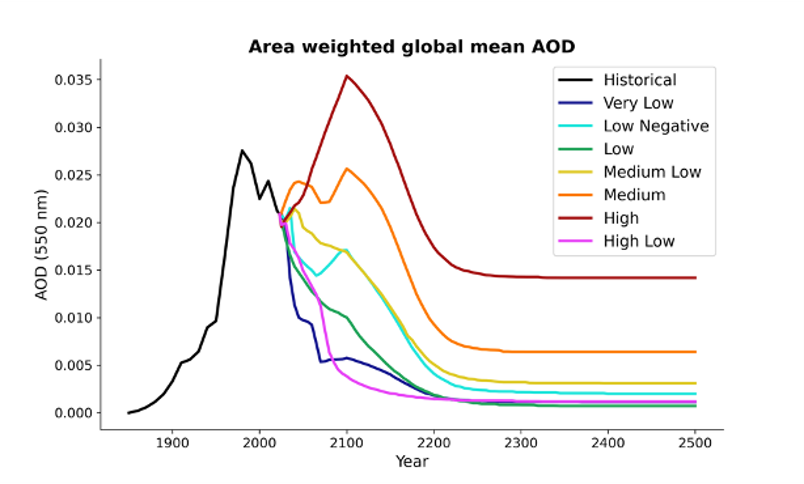
The Simple Plumes (SP) parameterization was first developed for use in CMIP6 simulations and has been used for several applications beyond; SP captures the spatial variability in anthropogenic aerosol properties. Specifically, the dataset represents aerosol optical properties and their associated effects on cloud droplets, scaling them over time with CMIP7 emission data.
A key strength of the new dataset is that the update of the historical period (1850–2023) differs only slightly from the CMIP6 version, allowing new model simulations to remain comparable with previous work while enabling studies of future climate through 2500. The development and release of these datasets was supported by the projects EXPECT and ForceDestinE.
All published data are freely available on Zenodo. More information on SP and previous datasets can be found here.
Fiedler, S., Leibensperger III, R. J., and Azoulay, A.: CMIP7 Climate Forcings Dataset: Simple plumes for anthropogenic aerosols in extended CMIP7 scenarios, 2026.