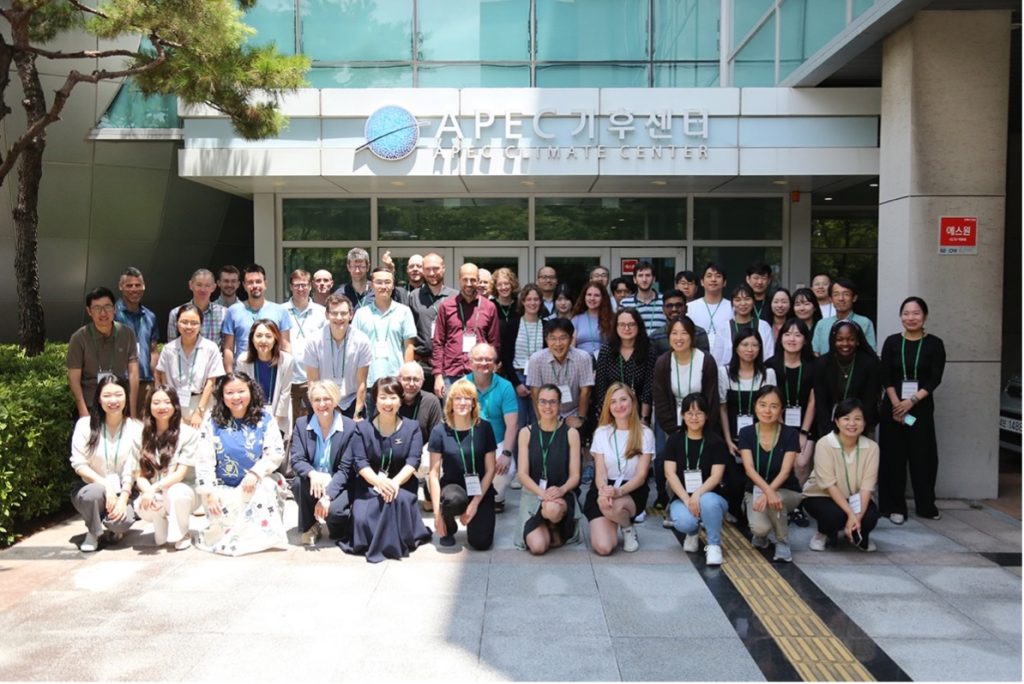
EXPECT experts headed to Busan, South Korea, from 15 to 18 July to attend the Joint Science Meeting between the Lighthouse Activity on Explaining and Predicting Earth System Change (EPESC) & Large Ensembles for Attribution of Dynamically-driven ExtRemes (LEADER), an activity of the Core Project Atmospheric Processes And their Role in Climate (APARC).
The meeting focused on advancing understanding and prediction of Earth system changes, emphasising the role of external forcing and internal variability, and exploring the operationalization of decadal forecasts.
Melissa Seabrook and Doug Smith, researchers at Met Office, attended the sessions in person. Building on his presentation ‘The need to account for model error in attribution and prediction’ Doug Smith led the discussion about an analysis plan in the framework of the Large Ensemble Single Forcing Model Intercomparison Project (LESFMIP), and hosted a breakout session about model errors including the signal to noise paradox. Melissa Seabrook presented on ‘Multidecadal Pacific Atmospheric Circulation Trends and their Drivers’.
Other EXPECT researchers joined the conversation online. Markus Donat, scientific coordinator of EXPECT, and Gerard Marcet-Carbonell, researchers at Barcelona Supercomputing Center gave presentations on understanding drivers of observed atmospheric circulation changes, and sources of predictability for drought in Australia, respectively.
Regarding the analysis plan agreed within the Large Ensemble Single Forcing Model Intercomparison Project (LESFMIP), the following steps were defined:
- Discontinue reliance on the multimodel ensemble mean when models produce divergent responses – the true response may not resemble any individual model, and in the presence of signal-to-noise errors, it is unlikely to match any of them.
- Seek to identify the true response by making use of differences across models.
- Test explicitly for signal-to-noise errors.
- Avoid interpreting ensemble member spread when signal-to-noise errors are present.